| Double-edged |
| Expediency |
| Crappiest company |
| Efficiency |
| Info you likely don't know |
| Technical oversights |
| Failures |
| Untruths |
| Londonism |
 Click for DECEITFUL
|
| What should I do? |
- A long-term perspective
- Abi-Res is a river regulation scheme
- Chalk Streams First – a misguided policy?
- Chess problem
- Chalk Streams First – a review
- Binnies
A long-term perspective
Joining their Eastern Division in January 1976 as operational hydrologist, I gained great experience and close access to senior managers & engineers working in many aspects of North West Water Authority's water resources & water supplies. The 1976 drought was nationally very significant, and proved very testing in NW England from April onwards. I remember the great humour and common sense that broke out that year.Using your wooden head works
The Peak District Headworks Engineer got wind of a suggestion to help Yorkshire Water Authority by laying an emergency pipeline through the Woodhead Railway Tunnel from Woodhead Reservoir to Dunsford Bridge, immediately below YWA's Winscar Reservoir. He quietly arranged for water to be released from Woodhead Reservoir to descend to Torside and Rhodeswood Reservoirs further down the chain of five Longdendale reservoirs. That ended the debate. His judgement was correct. Such was the severity of the drought in NW England, NWWA needed every drop themselves.
Why is this relevant? Thames Water chose to use a dramatic 9 May 2025 photo of drawn-down Woodhead Reservoir to illustrate Why we need a new reservoir
. See p5 of the SESRO Summer Project Update. Water cannot be supplied from Woodhead Reservoir. It has to be moved down the valley. It is prudent to do so in drought conditions. In this area of the Dark Peak, discoloration and sediment are expected in first-flush storm runoff following prolonged dry weather. So it's best kept separate. But, hey, the drawn-down reservoir made a great photo.
Things that have changed since 1976
Obviously, an awful lot has changed. In 1976, resources were nominally operated with a 2% annual risk of failure (of being able to supply water) through a so-called 1-in-50 year drought. This meant that water-use restrictions had to be brought in in quite a number of dry years. You know, appeals for economy, hosepipe bans and suggestions to share a bath with your neighbour. The 1976 drought proved to be sufficiently severe that standpipes or rota cuts were needed in some areas.Life is very different in 2025. Companies are reluctant to ask for user economies or even to introduce hosepipe bans: with one exception. Companies are reluctant to restrict commercial use of water in any way. A typical criterion applied by Ofwat and the Environment Agency is that the water company must know exactly how it will operate its water resource systems when faced with a 1-in-500 year drought. That's a tenfold increase in water resource reliability.
No wonder new resource schemes are needed. Both the method of assessment and the level of detail in the setting of regulations for drought restrictions are mind-blowing. Although there is codified protection for the environment as well as to the consumer, the approach is fundamentally too close to business as usual
. Customers have paid for their water. It must be delivered with the fewest possible restrictions.
You probably think this old-timer is inventing stuff. So here it is in black and white. It's Government instruction to water companies: You should plan so that your system is resilient to a 0.2% annual chance of failure caused by drought, where failure is defined as implementing an emergency drought order.
... You should aim to achieve this level of resilience by 2039.
This is bonkers. No wonder water companies need to plan new resource schemes. If only they spent their time and our money on leakage reduction, metering and pollution control.
Climate change
Climate change is real and must be planned for. The Water Resource Management Plans that companies agree with Ofwat and the Environment Agency make due allowance for this — on the resource side. But at what stage of climate modification will it be prudent to convince consumers to change their lifestyles and value water more fully? A fully privatised water sector — you know, what no nation on earth but England has — is remarkably poorly equipped to do this. For the companies, water use is income.Pollution
River water quality has degraded badly. It wasn't perfect in 1976 but there was improvement up to about 2000 before the calamitous decline in the current century. It's obvious that Government and Water Companies aided by the voluntary sector should be utterly striving to reduce water pollution. Pollution is the biggest enemy. The Water Companies should be put on the rack to reduce spillage from their sewer networks. The Event Duration Monitoring of sewage overflows was a welcome — if long overdue — advance: one that bases judgements on solid(s) data.Unaccounted-for water
The bullsh*t statements by Thames Water on leakage reduction are simply stunning. Much money has undoubtedly been spent on addressing mains leakage, and more is planned to be spent. But how much has actually been achieved? Especially in the Big Smoke, shortcuts are taken. There is very little accountability.Even in the hectic year of the 1976 drought, NWWA Eastern Division's newly appointed hydrologist had to complete the annual return to Government of unaccounted-for water, i.e. water that had left NWWA's headworks
but likely hadn't reached the customer. It seems that the UFW term is still used although companies prefer to call it non-revenue water. That says it all.
Environmental causes
Another change over the last 50 years is more difficult to challenge: the much wider and deeper public interest in environmental matters, not least ecology. One might think this was wholly for the public good. But it's not always that simple. However well-intentioned, the Chalk Streams First policy looks likely to export environmental harm at huge expense.Abi-Res is a river regulation scheme
The SESRO proposal is for a river regulation scheme. Water released from Abi-Res will be abstracted from the Thames for public supply: principally in London. Thames Water portray this as efficient use of the river as an aqueduct to London. It is incomprehensible that the river regulation aspect of SESRO is missing from Government and Thames Water statements. Is it even referenced in the documents released for the Statutory Consultation?Dee Regulation Scheme – History
When moving from operational hydrology in North West Water Authority to applied research at the Institute of Hydrology in 1979, the first thing I worked on was flow forecasting for the River Dee in North Wales. I helped with some minor tweaks.The internationally famous Dee Regulation Scheme already had a considerable history and a long period of knowledge gain. Sluices at Llyn Tegid (Bala Lake) were used to regulate flows in the Dee from the late 1950s. Completion of Celyn Reservoir in 1965 specifically provided a large storage for river regulation. Then in 1979, the first stage of Brenig Reservoir on the Alwen tributary further increased the storage available to regulate the Dee.
Over the 60 years of its life to date, there have of course been changes. For example, some releases from Celyn support whitewater sports. But the Dee Regulation Scheme remains true to its original principles.
Dee Regulation Scheme – Principle of operation
Releases from Celyn and Brenig Reservoirs — coupled with intermediate adjustments of sluices at Llyn Tegid — regulate flows in the River Dee. The largest abstractor is United Utilities who take water at Huntington in Cheshire for public supply. In dry weather, the Dee flow at Manley Hall gauging station is encouraged to flat-line at 10 m3s-1.Hydrological forecasting of flows is crucial to the success of the scheme to ensure that reservoir releases are efficient: both to sustain the required abstraction (without compromising the licence) and to avoid over-releases (which effectively waste water). If inadequately forecast heavy rainfall occurs in the catchment intervening between the regulating reservoir and the abstraction point, it is inevitable that some or all of the released water will be wasted. These are known as regulation losses. Water resource schemes based on river regulation present a complex operational forecasting & control problem.
If TW were concerned about water resource efficiency, their SESRO proposal would be highlighting the importance of river monitoring, flow forecasting and having flexible intermediate control at Thames weirs. Where is this material?
Or is the post-SESRO licence (regulations of a different kind) for TW abstractions in London to be set so loosely by the Environment Agency that the company can take whatever it likes up to the maximum licensed amounts, perhaps taking out every drop it has released a certain number of hours earlier at Abi-Res? Are we even told the expected travel-time of releases in the drought conditions in which the reservoir will be releasing?
The Gate 1 decision by Rapid — no, I don't enjoy the mind-numbing jargon either — says:
The assessment of regulation losses was considered sufficient for gate one. The water companies will continue to develop the solutions and evidence surrounding them and are expanding on this work at gate two. The assessment of River Thames regulation losses is based on the same methodology as used by the assessment for River Severn regulation losses.
Well thanks for explaining! What methodology is that? In what sense is the regulation of the Severn comparable to regulation of the Thames? And what are the regulation losses evaluated for SESRO? Will the much dirtier nature of water in the Thames have an impact? Was all the Welsh Water Authority and international research on the Dee Regulation Scheme unnecessary?
To call SESRO half-baked is too kind.
Chalk Streams First – a misguided policy?
Chalk streams are very special. Bournes are tributary streams that flow only seasonally. They are a natural feature of Chalk catchments. Look at all the place-names in the Chalk areas of Southern England that include bourne in their name?The biggest enemy to a Chalk stream is pollution: pollution from agriculture, from highways, from dumping (past and present) and of course from sewage overflows. Invasive species (e.g. Himalayan balsam and the Signal crayfish) and the loss of good habitat can also be a problem in some Chalk streams.
But things have gone much further in the Chilterns. Chalk Streams First — a coalition of many groups interested in Chalk streams — has proved a devastatingly effective lobby group.
Bourne-again fundamentalists: what's the issue?
Environmental groups in the Chilterns have pressured Ofwat and the Environment Agency over decades to revoke groundwater abstraction licences of Affinity Water and Thames Water in order to restore a host of Chalk streams to their former glory.Their definition of former glory overlooks the built landscape and infrastructure. It is as if the built landscape and the Chalk streams are separate entities: one artificial, one real. We'll retain all the housing and infrastructure. But we must revert all the Chalk streams to their 19th Century state by forcing water companies to cease abstractions: even closing pumping stations that have been running for 150 years.
What do you think happens now that Ofwat and Government have bought into the Chalk Streams First agenda? Well, most of these six consequences ought to be obvious:
- More ample flows in classic headwater streams ✔
- Property floods more frequently
- Infrastructure fails
- River water quality downstream deteriorates
- Huge amounts of money need to be spent on renewals
- Environmental harm is potentially exported.
Consequences for southern Oxfordshire
Consequences of the Chalk Streams First policy run deep, not least for southern Oxfordshire.
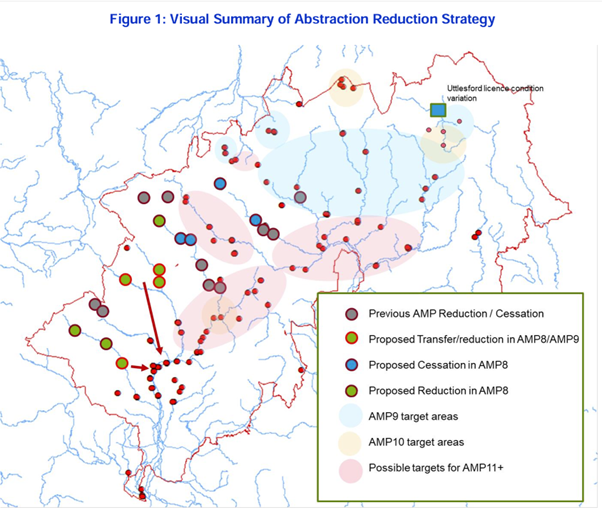
It's crucial to appreciate the geographical extent of Affinity Water's Abstraction Reduction Strategy. The map below is taken from p13:
|
Affinity Water need replacement water. Their preference is for SESRO and T2AT to make good the loss. [T2AT stands for the Thames to Affinity Transfer scheme. Important to omit W for Water there.] Page 4 of the SESRO Summer Project Update confirms that SESRO is in part designed to compensate for the loss of groundwater resource in the Chilterns: Chalk streams are extremely rare, ecologically vital and support a rich biodiversity. Only 200 chalk rivers are known globally, 85% of which are found in the UK in southern and eastern England. We and other water companies are looking to reduce the amount of water we take from these precious habitats.
Table 5 of John Lawson's 5 February 2023 report for Chalk Streams First suggests a total reduction in supplies across the Chilterns of 150 Ml/day. This is more than half of the 271 Ml/day that Page 6 of the SESRO Summer Project Update says Abi-Res will deliver initially. No wonder the Culham–Farmoor pipeline has been left out of SESRO. With London, Hampshire and the Chilterns taking priority, there isn't any spare for Oxfordshire and Swindon.
Many of the pumping station closures advocated by Chalk Streams First are now in the Water Resource Management Plans agreed with Ofwat. Affinity Water is the leader but TW will themselves cease groundwater abstraction at some sites in the Chilterns. The Chalk Streams First lobby has won hands down — and groundwater flooding up. If they centred their campaigning on reducing pollution of Chalk streams, I'd be with them.
You may be getting tired but you need to understand all the consequences of shutting down groundwater pumping stations in the Chilterns. Fortunately, theren's a well documented example.
Chess problem
A further update in the Thames Water media library confirms how extensive, technically advanced, well-intentioned and thoroughly embedded the Chalk Streams First philosophy is. This is for just one of the Chiltern chalk streams: the River Chess.Change at Chesham
Alma Road (aka Chesham) Pumping Station was built in the early/mid 1880s. A brief chronology of recent changes at the Pumping Station (PS) is provided by the Chilterns Chalk Streams project:Affinity Water voluntarily turned off their pumps at the site in 2020 to improve flows in the River Chess following years of campaigning by local community groups ...
In July 2024 however, the Environment Agency announced that it had issued a section 20 notice to Affinity Water to request that it restart abstraction at the site. The Agency confirmed that this was as a precautionary measure to address a potential increased risk of groundwater flooding identified by their regional groundwater model (in 2021).
The CCSP, RCA and Chiltern Society, led stakeholder calls for this decision to be reversed, arguing both that there was a lack of solid evidence to show that the risk of groundwater flooding had increased due to the closure, and the detrimental impact that it would have on flows in the river.
Following a series of meetings with the Agency over the summer and a period of consideration, the EA confirmed in October 2024 that they had agreed a pause on the proposal with Affinity Water and in March 2025 confirmed their intention to revoke Affinity Water's licence to abstract water at Chesham Pumping Station ... . The news from the Agency this month that this process is now complete brings to an end nearly 150 years of water abstraction at the site.
Consequence for infrastructure (adverse)
Excuse me? Does liquid evidence not count? 23 Jun 2025 news report:A call has been issued for urgent action to deal with stagnant water in an underpass which has been closed for five years.
Thames Water (not just Affinity Water) is involved in improving
the River Chess. New network infrastructure is needed to bring sufficient water into the district to replace the loss to supply when TW stops abstracting at Hawridge PS in 2030.
Consequence for property flooding (adverse)
A major flood resilience project is pending in Chesham. Schedules have been delayed by high groundwater levels obstructing utility diversions, though there's no mention that this might be linked to the cessation of groundwater abstraction. If the £3.3m Pednormead End flood resilience project has been devised to meet the flood propensity of the Chess prior to 2020, there will be disappointment ahead.Consequence for river water quality (adverse)
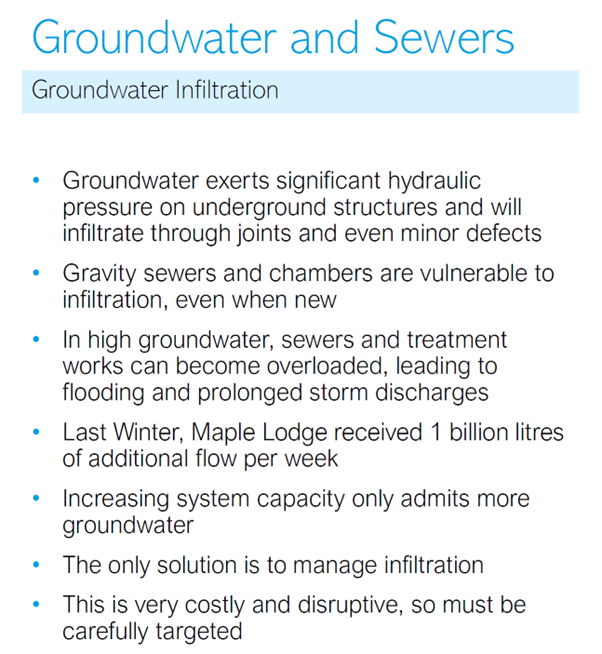
The River Chess lies within the Colne catchment NW of London. Many community groups have done excellent work, including the River Colne Catchment Action Network (CAN) which undertook extensive monitoring through collaborative and Citizen Science initiatives. Here's a link to a summary of their findings in 2021-2025.There were impressive presentations to a Colne CAN workshop held on 2 Oct 2024. I found the Thames Water presentation on the evolution of Colne Valley sewerage especially informative. Slide 59 captures their insight into the problem of groundwater infiltration into sewers in the Chess catchment:
|
Chalk Streams First – a review
How does revoking licences for major long-term groundwater abstractions help? You gain nicer looking headwater streams: with bournes that flow over longer lengths of the Chalk valley, and for longer periods. But Chalk streams that run dry are natural. Habitat gains are stronger in the eye of the observer. One species takes advantage as another suffers. Who are we to say which are most deserving?The adverse consequences of revoking licences for major long-term groundwater abstractions in the Chilterns are to:
- Exacerbate property & infrastructure flooding
- Worsen water quality lower down the river system (because of the more frequent ingress of groundwater into sewers)
- Require sewer network upgrades
- Require new water supplies and associated network infrastructure.
The John Lawson report
I value the thinking and research undertaken by John Lawson. The final report (5 Feb 2023) is a tough read for the non-specialist; there's much technical content. It is disturbing that the report stretches quite so far into policy recommendations. It seems that this was because there was a second author. Lawson wisely references this on Page 2 of the report (which is Page 8 of the PDF):

|
I will not blame the many groups supporting the CSF coalition for the gross environmental harm to southern Oxfordshire if Abi-Res proceeds. However, these groups will have this on their charge sheet if they remain silent or choose to assert that southern Oxfordshire's environment is unimportant.
I suggest that it would be a mistake for the Chalk Streams First coalition to settle back and rely on Affinity Water's preferred solution of SESRO and T2AT being delivered. John Lawson makes excellent points about the fate and potential redeployment of the groundwater resource freed up by the Chalk Streams First policy. Of particular merit is his broad suggestion for Thames Water to exploit groundwater storage more progressively. He points to the West Berkshire Groundwater Scheme as the kind of resource to emulate in London.
I speak only as an individual and do my best not to speak outside my knowledge or experience. I have direct experience of the effect of closing a long-term groundwater pumping station: the one at High Royds Hospital, Menston, West Yorkshire. I've done very many site-specific studies of flood risk in my career. This one intrigued me more than any other. Based on six weeks' intensive research, it's a tough but fascinating read.
Opportunities
There's a great snap of the Affinity Water CEO starring in a World Rivers Day
photo opportunity on 27 Sep 2020. Being a water-supply-only company, Affinity do not need to worry about the adverse consequence of higher groundwater levels for sewer networks.
Pauline Walsh did not last long; she stepped down with immediate effect on 9 Sep 2021. One of her current roles is as Senior Operating Partner for Macquarie Asset Management. Now where have I heard that name?
Binnies
Why did the name Binnies disappear for 25 years? Throughout much of the 20th Century, Binnie & Partners enjoyed a peerless reputation in the UK water sector until their mis-design of the Lune-Wyre transfer tunnel: part of NWWA's Lancashire Conjunctive Use Scheme. Sixteen died and many sustained life-changing injuries in the Abbeystead Disaster of 23 May 1984.The HSE summary: The explosion was caused by the ignition of a mixture of methane and air, which had accumulated in the valve house. The methane had been displaced from a void, which had formed in the end of the Wyresdale Tunnel during a period of 17 days before the explosion when no water was pumped through the system.
Reviewing the incident and media coverage 38 years later, the mouthpiece of UK civil engineering summarised: A Court of Appeal ruling four years later found the designers Binnie & Partners wholly to blame for the disaster, a decision which most knowledgeable commentators — including NCE — thought grossly unfair.
This commentator does not agree. The possibility of methane ought to have been anticipated. Where Binnies were unlucky was that the public visit to the valve chamber was wholly inappropriate. I was appalled that an experienced hydrologist had not been deployed (or had not been able) to convince the public that the Lune-Wyre transfer could not add appreciably to flood risk on the River Wyre.
RSK acquired Black & Veatch's UK and Asia water businesses in 2021, and rebadged them to operate under the returning brand of Binnies
. We are Binnies. Supporting our clients for a better world. We are proud of our more than 100-year heritage.
Well, not quite all of it.