| Double-edged |
| Expediency |
| Crappiest company |
| Efficiency |
| Info you likely don't know |
| Technical oversights |
| Failures |
| Untruths |
| Londonism |
 Click for DECEITFUL
|
| What should I do? |
Why is Thames Water such a very bad company?
It's easy to blame the Aussies. Macquarie took Thames Water over in 2006 and took advantage of the very weak regulatory regime for over a decade. Overseas owners and obscure financial arrangements got applied to our most precious substance (water), not just to our national sport.
But changes to water and sewerage in 1974 put through by Ted Heath's government sowed the seeds for Thames to be a bad company long before privatisation in 1989. North West Water Authority was formed by amalgamating the historically powerful Corporation Water Works of Manchester (MCWW) and Liverpool (LCWW) along with many lesser water undertakings, including the differently skilled Fylde Water Board. It took time, but there was cross-learning and metropolitan influences on water were diluted.
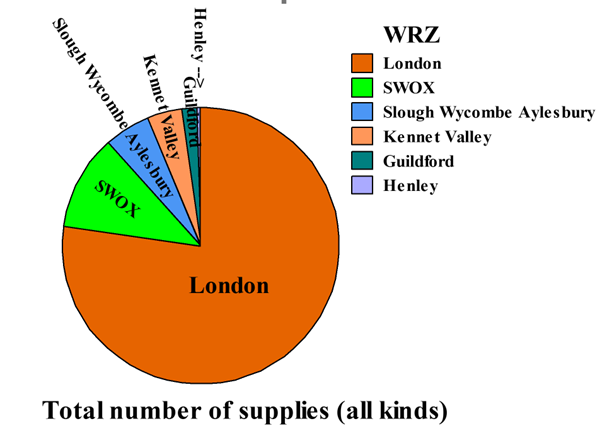
In contrast, Thames Water Authority was built out of London's Metropolitan Water Board and sundry authorities in the Thames valley. The metropolitan influence on water continued to dominate. The diagram below refers to the number of supply connections (households and non-households) in the six Water Resource Zones used by Thames Water today. SWOX is the Swindon-Oxford zone commanded by Farmoor Reservoir.
|
The dominance of London was always thus. In his report on the first year of Thames Water Authority in 1974, one might have expected the Chairman to highlight integration. Instead: If we have already had some success, we must thank our predecessors. The Metropolitan Water Board, the Thames Conservancy and the GLC main drainage undertaking, to mention only three, were internationally famous. They have bequeathed us standards of excellence which we are determined to maintain and improve.
It really is the crappiest company
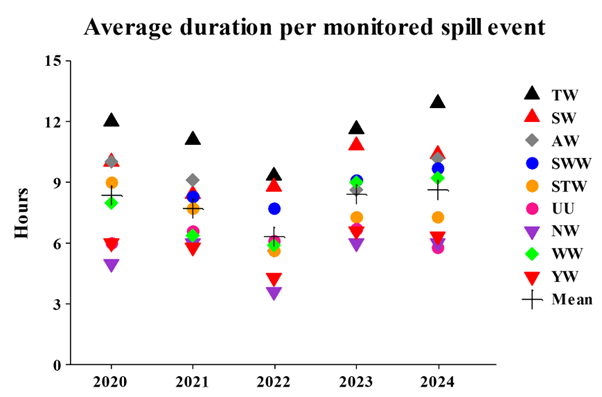
Following ever-deteriorating river water quality — and many years of intense public complaint — David Cameron's Government finally got the regulators to force Water-and-Sewerage Companies (WaSCs) to monitor and publish data on storm overflows from their sewage works and trunk sewers. The pollution ends up in the river or coastal waters (though only the river in the TW region). As the name suggests, these overflows should only operate in storm conditions. If only.Event Duration Monitoring (EDM) gathers information on the number, frequency, character and duration of these spills. Since 2020, the WaSCs have returned EDM data annually to the Environment Agency. A key number is the average duration in hours of such spills. By this criterion, Thames Water (TW) is consistently the crappiest of the nine Water-and-Sewerage Companies principally serving England. [SW and AW denote Southern Water and Anglian Water: the adjacent WaSCs in South East England.]
|
Oxfordshire — the most crapped-on county?
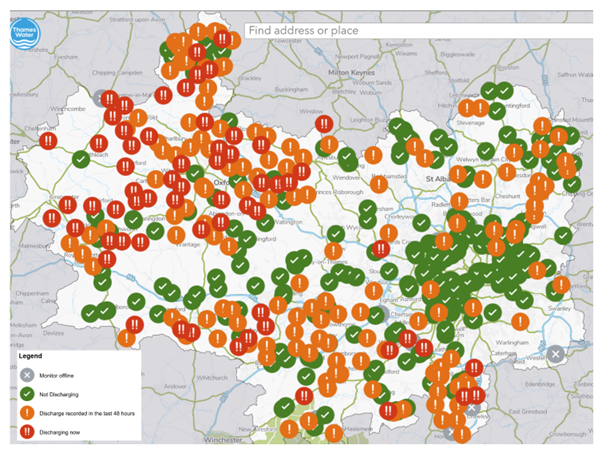
Here's a snapshot from TW's live map of EDM data taken at 9pm on 20 December 2025. What do you notice?
|
Sensibly, the red icons plot on top of amber, and amber on top of green. It's worth noting that the denser network in London means that a few red or amber icons can readily conceal a generally green performance undereneath. You just need to zoom to confirm this.
The strong performance in London is doubtless a measure of the Thames Tideway Tunnel (TTT) and associated upgrades, to which bill-payers outside London are contributing pro rata. The idea that TW customers in Oxfordshire (and parts of Gloucestershire and Wiltshire) are being equally well served is tosh. [In the late 19th Century a tosher
was a person who scavenged for valuable items in the sewers of London.] London bill-payers — who form about 80% of TW's clientele? — are clearly not contributing enough to get compliance at storm sewer overflows in the wider Thames Water region. Yet more Londonism.