| Double-edged |
| Expediency |
| Crappiest company |
| Efficiency |
| Info you likely don't know |
| Technical oversights |
| Failures |
| Untruths |
| Londonism |
 Click for DECEITFUL
|
| What should I do? |
Desalination
A 2 Oct 2025 report in Water Magazine: Thames Water's £500 million desalination plant in Beckton, East London, has operated for just seven days over the past 15 years, sparking criticism from environmentalists and MPs begins:Officially known as the Thames Gateway Water Treatment Works, the plant was designed to convert brackish water from the River Thames into potable water using reverse osmosis, with a capacity of up to 100 million litres per day. However, it has been largely inactive since its completion in 2010.[The above report is a little misleading. The desalination plant was intended to deliver up to 150 million litres per day, and to do so continuously whilst drought flows in the Thames remained low.] TW's drought plan notes:To this date the plant has only been operational on five occasions, providing about seven days of London's water supply. At a total cost of £518 million, that works out to about 7p per litre, 28 times the typical water cost.
The plant is permitted to operate only during drought conditions, specifically when river flows fall below 3,000 megalitres per day. Despite several drought periods, it has remained offline due to maintenance issues, chemical hazards, and health and safety concerns.
The material changes we have made in this [2022] Drought Plan include the reduction in the output associated with the Thames Gateway Water Treatment works, from 150 Ml/d to 100 Ml/d.
I do not have the data necessary to check the magazine's unit-cost calculation. The desalinated water may sound expensive. But the scheme was only designed for use in a major drought or other emergency.
What hurts is the plant's poor reliability and that its deployable output has been formally reduced. This is failure on top of failure. A missed opportunity.
Leakage
It is fun to viewWill taps run dry?, a 1965 edition in the
Look at Lifeseries. Running for just eight minutes, the film captures many familiar problems and work to address them. If you've only seconds to spare, maybe start viewing at 3:20?
Water authorities aim to keep leakages in their pipelines down to 10%. I wish.
Most things that TW say about leakage are projections rather than factual. A failure to deliver what has been promised is seldom reported unless it has attracted a substantial fine from Ofwat e.g. in 2018.
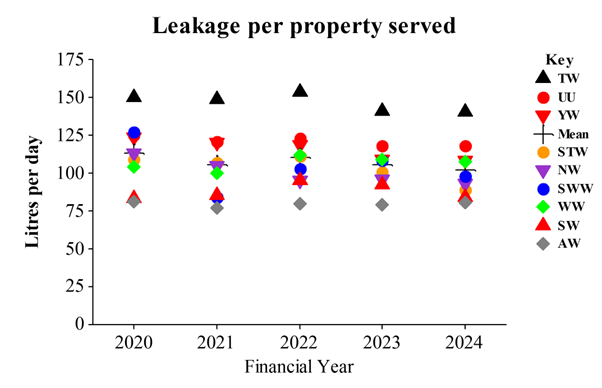
I had thought that leakage reporting might still be a dark art. Although regulation remains weak, more about the comparative performance of companies is now in the public domain. Data published by the Consumer Council for Water includes annual leakage figures expressed per property served, from which the comparison graph below derives. It shows leakage data for the nine Water and Sewerage Companies (WaSCs) principally operating in England:
|
What is spent on leakage control is immaterial. It is what is delivered that matters. My theory is that companies progressive in metering are better informed and more active in leakage control. This is borne out by the good performance by Anglian Water and Southern Water on both fronts.
The performance of Thames Water is staggeringly bad in these crucial aspects of water management:
- They are the most polluting WaSC principally operating in England.
- They have a very weak performance in terms of metering compared to other WaSCs operating in the water-stressed South and East of England
- They are the leakiest WaSC principally operating in England.
Groundwater storage schemes
Abi-Res is principally storing water for London. Why not store it underground and closer to London?The failure to develop further groundwater storage schemes is inexplicable.
Any concern about water quality just adds to the imperative that Ofwat, the Environment Agency and water companies target all practices & omissions that lead to the pollution of water. The correct policy is obvious.
Page 17 of Keeping water flowing: A summary of our Water Resources Management Plan 2024 includes: Groundwater storage This involves making changes to existing groundwater storage (where sustainable) or using an innovative technique called Aquifer Storage and Recovery (ASR) to store additional water underground.
The only innovation is the term Aquifer Storage and Recovery
. Groundwater recharge schemes have been around for decades:
- The West Berkshire Groundwater Scheme was commissioned in the 1970s as a drought augmentation scheme specifically for Thames Water.
- Evolution of the North London Artificial Recharge Scheme (NLARS) has been over a similar timeframe but with extensions and operational changes made over the last 25 years.
NLARS is now evolving to allow the management of shorter-term operational requirements. Some boreholes have recently been equipped to provide direct supply to the network during annual peak demands. Should this mode of operation prove successful then it may be adopted elsewhere in the Scheme.
It is scandalous that Thames Water has exploited NLARS to make operational savings. More convenience for London. A resource developed specifically to augment drought supplies has been perverted.
TW's downplaying of groundwater augmentation schemes is necessary to help build the case for SESRO aka Abi-Res as a shiny asset to attract investors and keep the company afloat. It has nothing at all to do with necessity. Bringing Southern Water and Affinity Water along is a figleaf to try to make SESRO look essential.
Where exactly is the groundwater going after the ongoing cessation of Affinity Water and TW abstractions in the Chilterns? It's topping up aquifers under London and going into the Rivers Colne and Lea.
I applaud the thinking and research undertaken by John Lawson. In the final report (5 Feb 2023), Lawson makes excellent points about the fate and potential redeployment in London of the groundwater resource freed up by the Chalk Streams First policy. Of particular merit is his broad suggestion for Thames Water to exploit groundwater storage more progressively. He wisely points to the West Berkshire Groundwater Scheme as the kind of resource to emulate in London. In principle, the conjunctive use of the chalk aquifer and the reservoirs downstream appears a much better way of using the chalk water resource, with far less impact on chalk streams than continuous pumping of water supplies directly from the chalk.
It is crazy that there is no mention of groundwater recharge: even in Shape your water future: Our Water Resources Management Plan 2020 – 2100.