| Double-edged |
| Expediency |
| Crappiest company |
| Efficiency |
| Info you likely don't know |
| Technical oversights |
| Failures |
| Untruths |
| Londonism |
 Click for DECEITFUL
|
| What should I do? |
Reservoir Advisory Panel
The Reservoir Advisory Panel appointed to SESRO has technical class and a healthy streak of independence. So I am confident that technical oversight (i.e. overseeing) of the structural design & safety provisions for SESRO will be suitably thorough. I trust that the Reservoir Advisory Panel will ensure that the designers consider the ability of the Abi-Res embankment to withstand an extreme flood on the River Ock.But what of technical oversights of the other kind?
Floodplains and watercourses
TheSESRO Summer 2025 update – map bookis dreadful in its portrayal of watercourses. The maps presented are based on a mix of sources: none of them Ordnance Survey. Conventions for representing watercourse widths are subverted.
It is difficult to discern which tributaries of the Ock are to be left unaltered, and which are to be diverted: some to pass NW of Abi-Res and some to pass SE of Abi-Res.
The most prominent feature on the Preferred design options map
is the Safeguarded Wilts & Berks Canal Corridor
. This is a work of fiction. The corridor lies fully in the floodplain of the River Ock and its Childrey Brook tributary. According to the said map, the safeguarded route crosses at least six tributaries. These factors make construction of the canal along this new route utterly impractical. In contrast, the route of the Old Canal
crosses no watercourses shown on OS 1:25000 mapping. Canal designers in 1784-1810 had common sense.
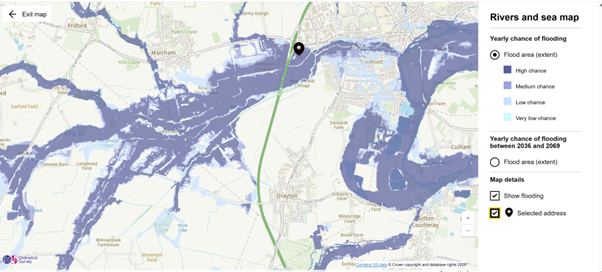
SESRO in relation to floodplains
There is misleading implication that SESRO will leave the 100-year floodplain of the Ock unaffected. This might coinceivably be feasible for the named River Ock, with the exception of the site-access roads and the treatment works for the supply to Southern Water. However, it is clearly false for southern tributaries to the Ock.
|
Where is it stated that compensatory floodplain storage will be provided for those parts of the Ock and Thames floodplains on to which the SESRO works and buildings intrude: at Abi-Res and also near Culham?
It is not uncommon for supermarkets to be at risk of flooding. An extra-large one at Abingdon floods from the River Ock. The superstore is in prime position for increased turnover if SESRO proceeds. Swings and roundabouts. But there's no silver lining for property owners in southern Abingdon already at high risk of fluvial flooding.
SESRO in relation to an extreme flood on the River Ock
It is a very serious omission — presumably an oversight — that Thames Water have yet to consider the effect of an extreme flood on the River Ock. Reservoir Safety Guidelines state that a reservoir constructed as an earthen embankment and sited above a community (e.g. Abingdon) must be able to withstand a Probable Maximum Flood.The designers of SESRO will state that Abi-Res is a bunded reservoir rather than an impounding reservoir. Nevertheless, I suggest that a legal challenge would uphold that the reservoir embankments must be built to withstand an extreme flood on the Ock as it passes by. I do not think that the matter can be ducked.
I no longer have access to the relevant software. But my back-of-the-envelope calculation is that the 150 Gl volume of water released in the event of toe failure
undermining the embankment would be somewhat larger than the volume of the River Ock Probable Maximum Flood (PMF) itself. Abingdon would be devastated in either scenario.
I am confident that the Reservoir Advisory Panel will instruct that the extreme Ock flood used in testing for erosive failure needs to be at least a moderate fraction of the PMF.
Discharge of polluted water
It makes sense in principle to use the River Thames as the aqueduct to supply London. It's just a shame that the river is so polluted. There is diffuse pollution from agriculture, contaminated runoff from major highways & airports, landfill & fly-tipping and — of course — the concentrated discharge of untreated effluent from many Thames Water sewage works.All these pollutions are in essence incidental; no-one has discharged polluted water by design.
Cryptosporidiosis and cryptosporidium
Cryptosporidiosis is a disease characterised by persistent sickness and diarrhoea.There is no specific treatment for cryptosporidiosis. Most people with a healthy immune system will recover within one month.
It is caused by mobile oocysts
which carry a parasite called cryptosporidium. The parasite infects the intestine. It originates from animal faeces which can be washed off into rivers and lakes. Government advice on the disease includes You can become infected in a number of ways, including touching animals at a petting zoo. Swimming in contaminated water is another route to infection. But the largest UK outbreaks have occurred due to contaminated drinking water.
There have been many outbreaks of cryptosporidiosis linked to public water supply. A notable one at Brixham in Devon in May 2024 is currently the subject of legal action by the Drinking Water Inspectorate against South West Water.
The first large outbreak recorded in the UK was from water supplied from Farmoor Reservoir to Swindon and Oxford in late 1988 and early 1989. The outbreak occurred shortly before flotation of the privatised Water-and-Sewerage Companies. It was studied in considerable detail.
Treatment for cryptosporidium oocysts
The parasitic oocysts cannot be neutralised by chlorination. However, ozonation is an effective treatment. Another approach is to remove the oocysts (which are typically about 5 microns in size) by microfiltration. The SESRO treatment works planned to serve the piped supply to Southern Water will incorporate treatment for cryptosporidium oocysts.It seems remarkable that Thames Water intend to discharge raw water from Abi-Res into the Thames regardless of its quality. Oocysts are known to persist for long periods. They are very small and only marginally denser than water, making them very slow to settle to the bottom of a reservoir.
A discharge of polluted water from Abi-Res will not be incidental. It will be by design. The discharges will be at times of low flow. Will it be legal to intentionally discharge water containing cryptosporidium oocysts into the river? Or will the Environment Agency grant Thames Water an exemption?
I was assured by very senior staff on 26 November 2025 that that the company does not plan to monitor for cryptosporidium oocysts before water is abstracted at Culham and pumped into the reservoir. Checking their draft commitment to Maintain water quality in the reservoir see Page 12 of the draft commitments register we find only To manage the risk of debris, large vegetation and algae entering the intake/outfall structure and reducing the quality of the abstracted water, a debris boom will be installed on the River Thames.
Perhaps TW will reconsider this following swift work by an Exeter University medical student following the May 2024 cryptosporidium outbreak at Brixham.
Paragraph 5.1.3 of SESRO Supporting Document B Drinking Water Quality Risk Assessment Report
strongly indicates the intention to remove or inactivate cryptosporidium at water treatment works abstracting from the Thames rather than managing the contamination at Abi-Res. Bathers at the designated river beach at Wallingford beware.